ADVERTISEMENT
Visual context as grammar school for verbs
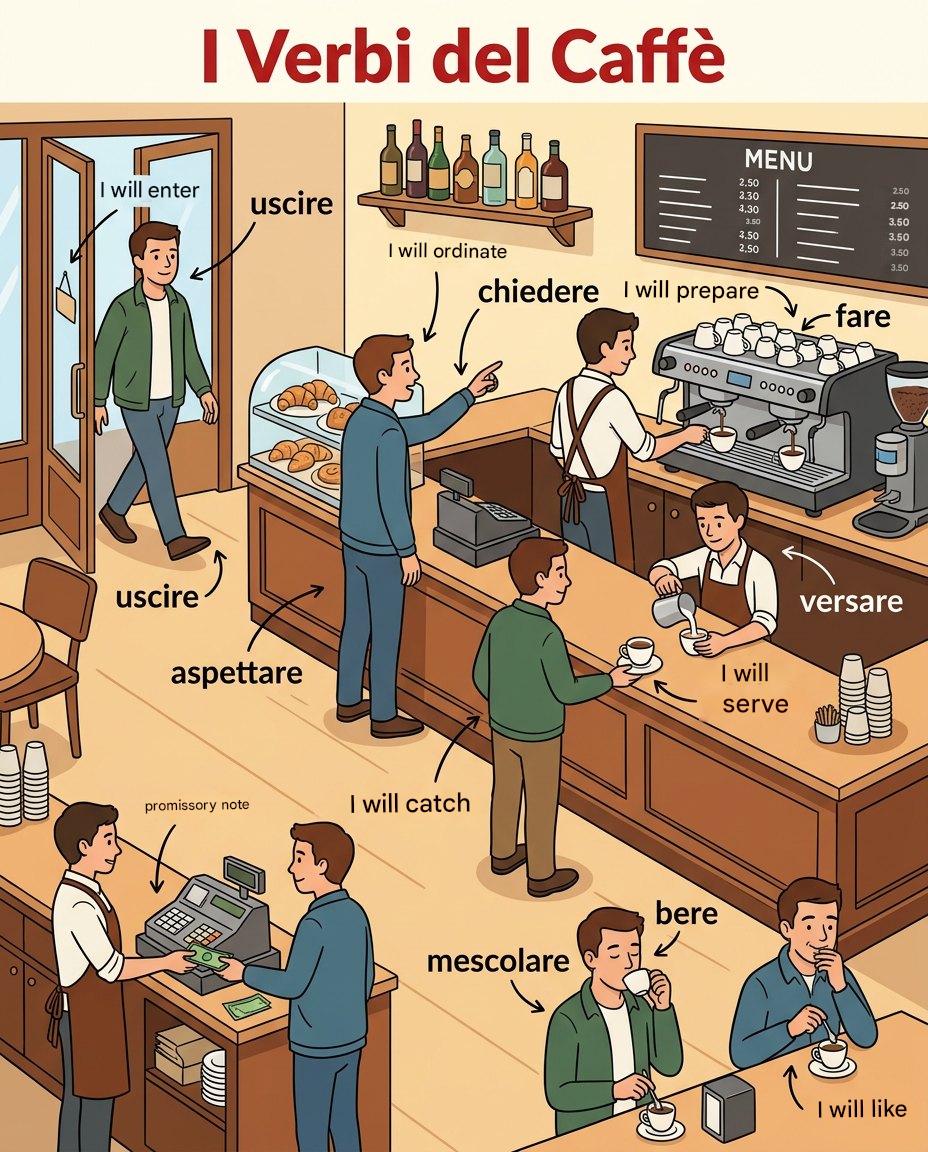
The illustration’s most obvious function is pedagogical: it attaches verbs to actions, giving learners immediate, embodied cues about meaning and usage. Rather than listing conjugations on a sterile white page, each verb — uscire, aspettare, chiedere, fare, versare, servire, mescolare, bere, and bere’s cousins — is anchored to a character in motion. This contextualization supports multiple cognitive pathways. Visual learners benefit from associative mapping (seeing someone pour coffee while reading versare); kinesthetic learners can mimic the actions and internalize the verb through motor memory; auditory learners can say the word aloud while pointing to the pictured action. The picture thus stages a mini-immersion: the classroom moves into a lived scene where vocabulary is not abstract but functional.
